
The era of experimentation in IT is over. The age of investments with measurable returns has begun. In the Edge One Solutions trendbook, we analyze how FinOps, Composable Enterprise, Data Mesh, Edge Computing, and AI-Driven QA will transform banking, retail, and industry – with a focus on tangible business outcomes rather than just a list of technologies.
The coming year may prove to be a turning point for the development of IT in business. After more than a decade of intensive investment in cloud, AI, and digital transformation, organizations are entering a phase of “technological efficiency.” Projects that are difficult to link to the P&L are becoming increasingly unacceptable — there is now an expectation of a clear, measurable impact on revenue, costs, or risk. Global analyses show that Enterprise Architecture teams and CIOs are now evaluated not by the number of systems implemented, but by portfolio rationalization, reduction of technical debt, and the development of composable architectures that increase agility at a controlled cost. (gartner.com)
In this context, IT leaders in banking, retail, and industry must answer two simple yet demanding questions:
How can new functionalities be delivered faster and more securely?
How can this be done more cost-effectively and efficiently — while maintaining compliance and quality?
Below, we analyze the key directions for 2026, showing not only the trends themselves, but also their implications for investment decisions and the practical steps worth considering.

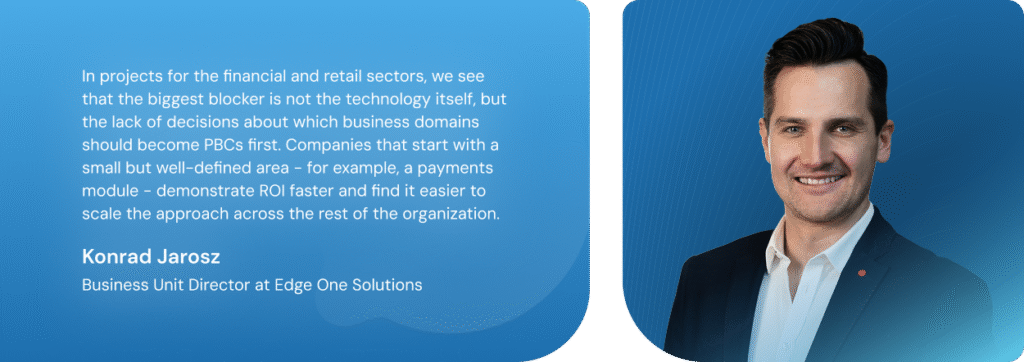
In 2026, the monolith finally gives way to the Composable Enterprise, which is no longer just a conference buzzword but is becoming a practical direction for system modernization. This is not only about microservices, but about the strategic building of systems based on Packaged Business Capabilities (PBCs) – modules representing specific business capabilities, such as settlements, scoring, a shopping cart, or a loyalty program. Analytical estimates show that the share of applications built on PBCs continues to grow. Composable enables 30% faster delivery of new functionalities and sales channels (Gartner, Top Trends in Data & Analytics (D&A)), mainly thanks to a smaller scope of changes when implementing a new feature, the ability to scale selected domains independently, and the easier replacement of elements that no longer support business goals.
For the banking sector, this means faster adaptation to new regulatory requirements and products, such as changes in scoring, new account types, or payment integrations. In retail and e-commerce, it means the ability to develop sales channels, promotions, and loyalty programs in parallel without stopping the entire platform.
Practical direction for action:
- Instead of rewriting the entire system, the organization identifies 3–5 key domains (e.g. payments, cart, loyalty, catalog, promotions) and separates them into PBCs.
- Implementing Headless Commerce or a Headless CMS makes it possible to decouple business logic from the presentation layer, which significantly accelerates experimentation across digital channels.

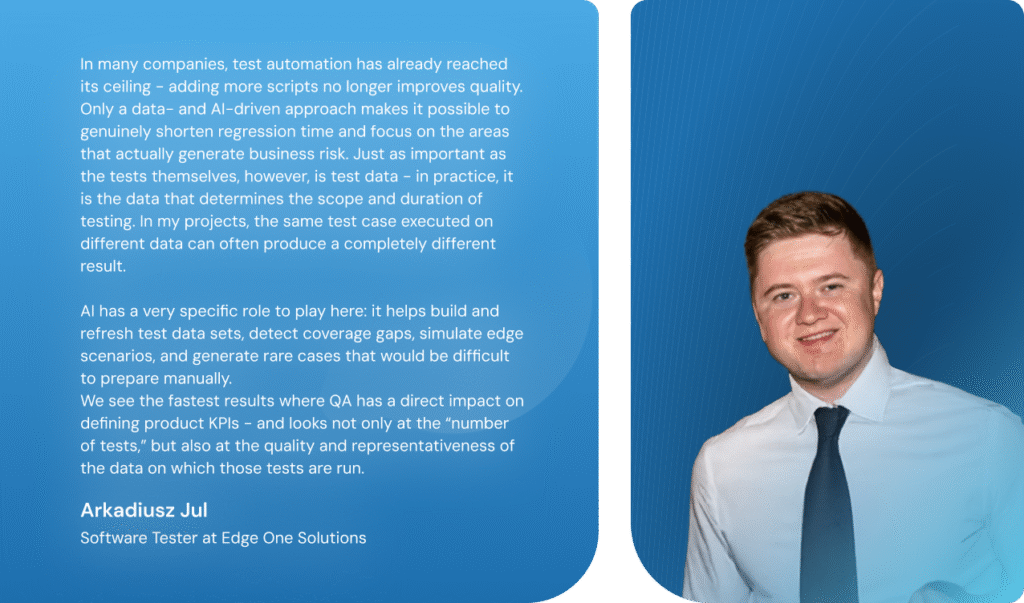
Shift Left culture has become the standard – testing is introduced as early as possible in the development lifecycle. In 2026, however, the real differentiator will be Hyperautomation in QA, where:
AI analyzes defect history, logs, and quality metrics,
automatically prioritizes high-risk scenarios,
predicts the areas where errors are most likely to occur (Defect Prediction).
Market research shows that organizations using AI-driven defect prediction and risk-based testing report a reduction in testing cycles and time-to-release by around 15–25%, while also decreasing the number of critical defects detected only in production.

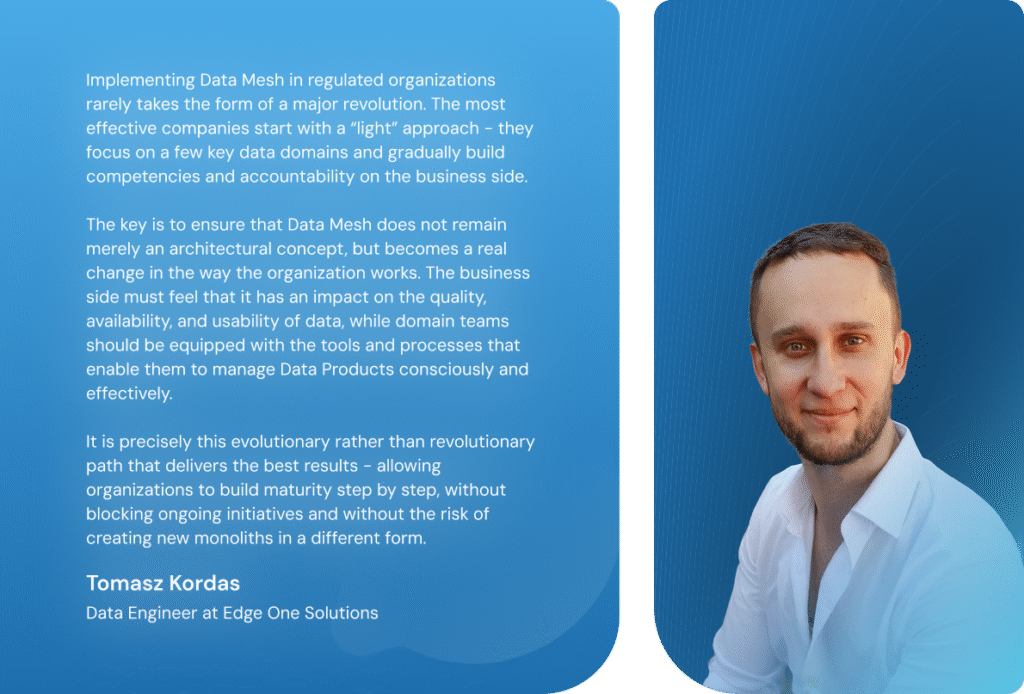
In the age of AI, the main challenge is no longer the volume of data, but the architecture of data management — and access to reliable, cleansed data is becoming the real fuel for organizations. This reliability stems not only from the accuracy of data sources, but also from data cleansing, standardization, and quality control processes at every stage of the data lifecycle. In regulated sectors such as finance and healthcare, interest in Data Mesh is growing — an approach in which data is treated as a product, managed by domain teams responsible for the entire data lifecycle.
In finance, Data Mesh enables independent business units (such as lending, risk, and compliance) to share data more quickly and securely for regulatory and analytical purposes, while in healthcare it ensures stronger Data Governance and compliance with GDPR, SOC 2, and CCPA.
Benefits of Data Mesh in regulated sectors:
better scalability of regulatory reporting,
faster access to data for analysts and AI teams while maintaining access control,
stronger business ownership of data (rather than leaving it solely to central BI/IT teams),
higher data quality as a result of standardization, cleansing, data lineage control, and ongoing validation at the domain level.
Practical direction for action:
Identify 2–3 domains where data bottlenecks are most strongly slowing down projects (e.g. regulatory reporting, fraud, customer 360).
Establish domain data teams (Data Owner + engineers + analysts) responsible for Data Products.
Define Data Governance standards (data lineage, sensitivity classification, access policies).
Control questions for the organization:
Do we have clearly defined business owners for our key data sets?
How much time passes from the need for a report or AI model training to gaining access to the relevant data?
Are we able to explain to a regulator where specific data in a report comes from?
How do our systems respond to the “right to be forgotten” — are we able to effectively remove a user’s data across all domains and systems without compromising the integrity of the remaining data?

The fact that cloud computing can ultimately be more cost-efficient than on-premise infrastructure is obvious. This does not change the fact that cloud environments also need to be properly optimized. The biggest challenge is turning cloud from an operating expense (OpEx) into an investment with measurable ROI. FinOps (Cloud Financial Operations) is now becoming an operational standard. Where should savings come from? Analyses show that the active implementation of FinOps leads to savings of 15% to 30% in cloud budgets (McKinsey, The FinOps Way: How to Avoid the Pitfalls to Realizing Cloud’s Value). This is not just about negotiating with providers, but about changing the culture — developers need to be aware of the costs of the resources they consume. GreenOps complements this approach by incorporating sustainability into savings metrics as well.
Practical direction for action:
- Build a transparent cost structure showing who consumes cloud resources and for what purpose (tagging, chargeback/showback).
- Establish shared responsibility for costs across IT, business, and finance teams (“shared responsibility” for the cloud budget).
- Automate the shutdown of unused environments (dev/test) and adjust capacity dynamically (rightsizing, autoscaling). Add carbon footprint and energy efficiency metrics to FinOps dashboards.
Control questions for the organization:
- Are we able to identify the top 10 most expensive cloud services and their business owners?
- Do developers see the actual cost of the resources they launch?
- How do we report the impact of the cloud environment on ESG goals?
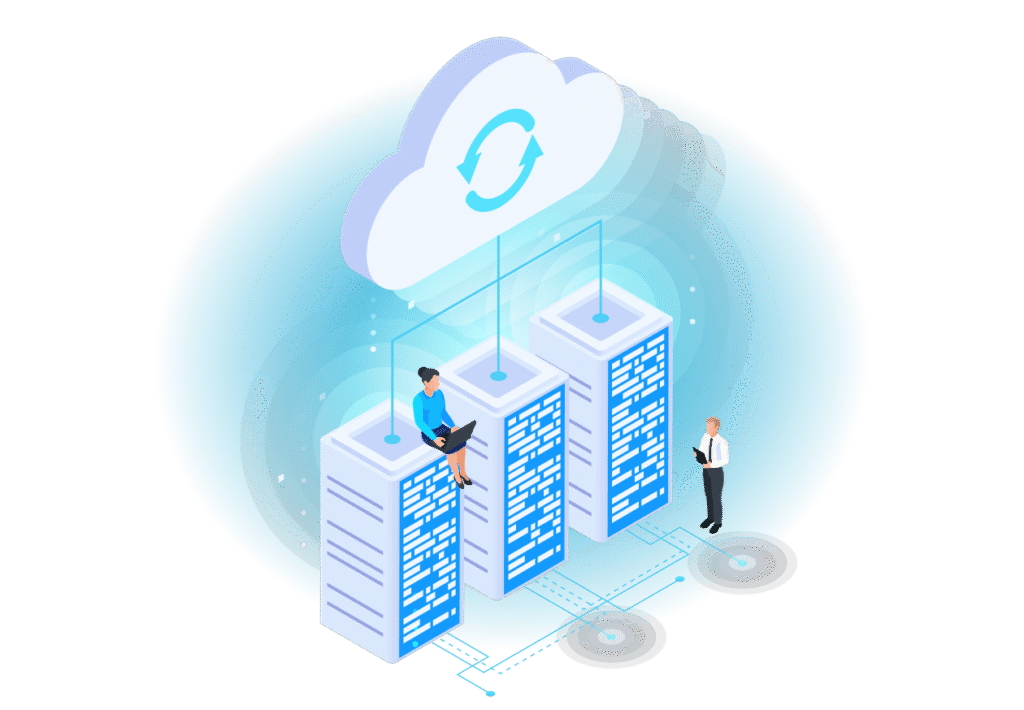
B2B mobile applications are moving beyond the central cloud to operate at the edge of the network (Edge Computing). This is critical in sectors where network latency is unacceptable. Where does the challenge lie? In manufacturing and industry, analytics at the edge of IT infrastructure enables real-time decision-making, such as predictive machine maintenance or immediate image-based quality control. This ecosystem is complemented by Offline-First applications that ensure process continuity in warehouses and production halls, where connectivity is often unstable.
Practical direction for action:
- Move critical business logic — such as service checklists, goods scanning, or preliminary sensor data analysis — to edge or mobile devices.
- Design a robust data synchronization mechanism, including queues, conflict resolution, and local data encryption.
- Clearly distinguish what must work offline and what can wait for synchronization with the central system.
Control questions for the organization:
- How many of our operational processes stop when connectivity is lost?
- Have we mapped “function degradation” scenarios — what happens to the application when the network is unavailable?
- What share of data really needs to be sent to the cloud in real time?
6.Project Management in 2026: The Dominance of Hybrid Models Instead of “Pure” Agile and Waterfall

In 2026, projects run in purely Scrum or Waterfall methodologies are becoming increasingly rare in B2B organizations. Growing regulatory pressure, the need for precise cost control, and the simultaneous requirement to deliver value quickly are making hybrid models the new standard. Companies combine Agile elements with Waterfall components in order to leverage the flexibility of iterative delivery, the predictability of budget and scope, and consistent governance mechanisms required at the PMO, audit, and compliance levels.
What do modern hybrid models look like?
1. Stable requirements documentation + iterative product development
In classic Waterfall, the list of requirements is frozen and documented in the form of BRD/FRD. In a hybrid model, the organization defines a stable high-level business scope upfront, while delivery teams work iteratively, managing the backlog in an Agile way.
This is not a “fixed backlog in Waterfall,” but rather a stable requirements baseline that serves as the input for iterative sprints and delivery cycles.
2. Different contract models within one project
Companies combine:
Fixed Price for components with a well-defined scope,
Time & Material for innovative areas or those requiring experimentation,
Managed Services for stable maintenance areas.
Such hybrid setups require strong scope, risk, and change management to avoid conflicts between a fixed-price model and the variable nature of an Agile environment.
3. PMO manages the portfolio in a mixed model
A modern PMO does not impose a single methodology. Instead:
some initiatives are run as products, with Product Owners responsible for business value,
some are run as traditional projects, with a clearly defined budget, scope, and timeline,
and all are evaluated according to a shared governance logic.
This requires consistent reporting processes — not only for status and costs, but also for business impact.
4. The evolving role of the Product Owner / Product Manager
The PO role is shifting from backlog management toward value management. In practice, this means:
participating in the creation of business KPIs,
being accountable for the ROI of functionalities,
working with PMO and business stakeholders on portfolio prioritization,
placing greater emphasis on data analysis (adoption, process impact, usage metrics).
In many organizations, the PO effectively becomes a Value Owner, operating beyond the traditional Scrum framework.
Practical directions for organizations
1. Introduce business metrics at the initiative level
Instead of trying to force business KPIs into the Definition of Done, which is not always realistic, companies apply a model based on:
hypothesis,
experiment,
measurement,
decision.
Business KPIs are assigned to sprint goals, epics, or releases, and impact is analyzed after a defined period of time, such as 30, 60, or 90 days. This approach makes it possible to increase value iteratively.
2. Establish clear rules for selecting the methodology and delivery model
The organization should have a standard initiative assessment framework that takes into account:
requirements maturity,
risk level,
integration complexity,
expected speed of delivery,
regulatory requirements.
The result should be a clear decision as to whether an initiative should follow Agile, Waterfall, or a hybrid model — and which specific hybrid variant.
3. Governance tailored to hybrid delivery — the most commonly missing element
Many organizations implement hybrid delivery at the level of ceremonies but overlook management. In reality, governance is what ensures consistency.
Key elements include:
clearly defined PM / PO / Business Owner roles,
a Stage-Gate process at the portfolio level,
consistent artifacts (vision, roadmap, release plan, status report),
decision-making rules for scope changes,
transparent escalation processes.
Without governance, hybrid delivery degenerates into chaos.
Control questions every organization should ask itself:
Is our current delivery model a response to actual business and regulatory needs, or simply a continuation of past practices?
How do we measure the effectiveness of sprints and releases — by the number of story points, or by real impact on business KPIs?
Is our PMO capable of managing a single portfolio in which Agile, Waterfall, and hybrid projects coexist?
Does our governance support team flexibility rather than suppress it?
Is the choice of methodology for each initiative a conscious decision, rather than a default option?
7. AI, GenAI, and Hyper-Personalization
We must not lose sight of the ever-accelerating momentum of solutions powered by artificial intelligence. After the initial phase of AI algorithm implementation, the time has come for far more advanced solutions based on generative artificial intelligence. GenAI is moving beyond purely experimental chatbots and taking on the role of generative decision-making agents in critical B2B processes.
Generative AI also supports hyper-personalization. It enables real-time segmentation and personalization of offers for B2B clients. In retail, this supports optimal assortment selection; in finance, it enables dynamic risk modeling.
At the same time, risk must also be addressed. Introducing AI Governance mechanisms and model auditing is becoming essential to ensure ethical use and avoid the risk of hallucinations in business-critical data.
8. The IT Environment in 2026 – From Innovation to Measurable Efficiency Through Modern Solutions
Based on the analysis of current trends, three strategic areas emerge as top priorities for decision-makers:
- Cost control and infrastructure optimization
The development of FinOps/GreenOps practices, rationalization of the application portfolio, and conscious decisions about what should be moved to the cloud and what should remain at the edge.
- Adaptive architecture enabling rapid change
Composable Enterprise, PBCs, API-first and headless approaches, as well as hybrid project management models that combine predictability with flexibility.
- Data and AI as a real source of business value
Data Mesh and Data Governance in regulated sectors, AI-driven QA and automation, as well as GenAI and hyper-personalization embedded in operational processes.
The direction for 2026 is clear: IT must finally stop being perceived as a cost center and become an accelerator of measurable efficiency and growth.
The organizations that succeed will be those that:
combine FinOps with Composable Enterprise,
build AI and GenAI on solid data foundations (Data Mesh, Governance),
automate quality (Hyperautomation QA) and move processing to where value is actually created — in production, in warehouses, and on customer devices (Edge & Offline-First).
Having the latest tools is only the beginning. The real challenge of 2026 will be the operationalization and integration of these technologies across the entire organization — so that every project has a clearly defined business goal, measurable KPIs, and a justified return on investment.