Introduction
Java is one of the most popular programming languages used to build business applications, SaaS platforms and enterprise systems. Its applications can run on different operating systems without requiring code modifications, which has been one of its greatest advantages for years.
Today, Java is a comprehensive technology ecosystem that includes JVM, Spring Boot, OpenJDK, Oracle Java and tools supporting system integration, cloud application development and AI implementation. This is why it remains the foundation of many systems used in finance, logistics, e-commerce, manufacturing and other sectors where stability, security and scalability are critical.
Despite the emergence of new technologies, Java continues to maintain its relevance. Regular updates, ongoing platform development and a vast community of specialists make it one of the most frequently chosen solutions for building systems that are expected to evolve for many years and support business-critical processes.
Why Is Java One of the Key Technologies at Edge One Solutions?
Since the beginning of Edge One Solutions, Java has remained one of the most frequently used technologies in our projects. Today, approximately 60% of our specialists work within the Java ecosystem, supporting clients in digital product development, legacy system modernization and the creation of new business applications.
By working with organizations from fintech, e-commerce, logistics, manufacturing and enterprise sectors, we observe that Java remains one of the most commonly chosen technologies wherever product development predictability, security and the ability to scale systems alongside business growth are essential.
For many of our clients, Java forms the foundation of systems responsible for payment processing, ERP integrations, large-scale data processing and the development of platforms used simultaneously by thousands of users.
What Business Benefits Does Java Offer Enterprises?
| Scalability Supporting Product Growth |
Java performs well in systems that handle a growing number of users, data and integrations. Thanks to its mature technology ecosystem, enterprises can develop products for many years without the need for costly architectural changes.
| Security and Compliance |
Java offers mature security mechanisms and regular updates that support data protection and compliance with organizational requirements. Combined with architecture audits and dependency management, it helps reduce operational and security risks.
| AI Integration with Existing Systems |
The modern Java ecosystem enables business applications to integrate with AI solutions without the need to build new systems from scratch. This allows organizations to implement automation and AI-driven capabilities faster while preserving their existing architecture.
| Talent Availability and Easier Team Scaling |
Java remains one of the most popular technologies used in enterprise environments. Broad specialist availability and the ability to support teams through technology partners increase product development predictability and reduce recruitment risks.
Does Java Still Make Sense for Business in 2026?
Many organizations wonder whether investing in a technology that has existed for decades is still justified. The popularity of new frameworks, the growth of AI and rapid market changes create pressure to look for alternatives. Making decisions based on trends rather than business requirements often leads to increased costs and reduced project predictability. A technology that is popular today will not necessarily be supported in five or ten years.
| Java remains one of the most actively developed enterprise platforms.
Modern Java versions (17, 21 and beyond) offer:- improved performance
- lower resource consumption
- support for cloud-native architectures
- an advanced AI integration ecosystem
|
At the same time, they maintain compatibility required by organizations operating long-established production systems.
Business impact: CTOs can continue developing products without the need for frequent system rewrites while minimizing technology risk.
When Is Java the Best Choice for an Enterprise?
Java performs particularly well in organizations developing business systems that require high reliability, scalability and long-term maintainability.
| System Type | Why Does Java Perform Well? |
|---|
| Financial Systems | Support for transactions, payments and processes requiring high reliability and security. |
| E-commerce Platforms | Ability to handle high traffic volumes, integrations and thousands of simultaneous operations. |
| Logistics Platforms | Efficient integration with partner systems, carriers and external data sources. |
| Manufacturing Systems | Integration with ERP, MES, WMS and systems supporting operational processes. |
| SaaS Platforms | Stable product development maintained by multiple teams over a long period. |
| Enterprise Systems | Support for complex architectures, high availability and long-term maintenance. |
In these areas, support from a technology partner experienced in Java application development, system architecture and maintenance cost optimization can significantly reduce business risk. The result is greater scalability, improved system stability and a lower risk of costly architectural changes in the future.
What Are the Real Costs of Maintaining Java Applications?
The cost of building a system is only part of the total investment. The highest costs usually appear after deployment. CTOs who focus exclusively on development costs often overlook maintenance, infrastructure, modernization and technical debt expenses.
What Determines the Cost of Maintaining a Java Application?
- Architecture: a poorly designed system will be expensive regardless of the programming language.
- Platform version: systems based on Java 8 or older versions usually generate higher operational costs.
- Automation: lack of CI/CD and observability increases the cost of every change.
- Team expertise: experienced Java developers and system architects can effectively limit the growth of technical debt.
Business impact: with the right architecture, Java often provides a more favorable total cost of ownership than many alternative technologies.
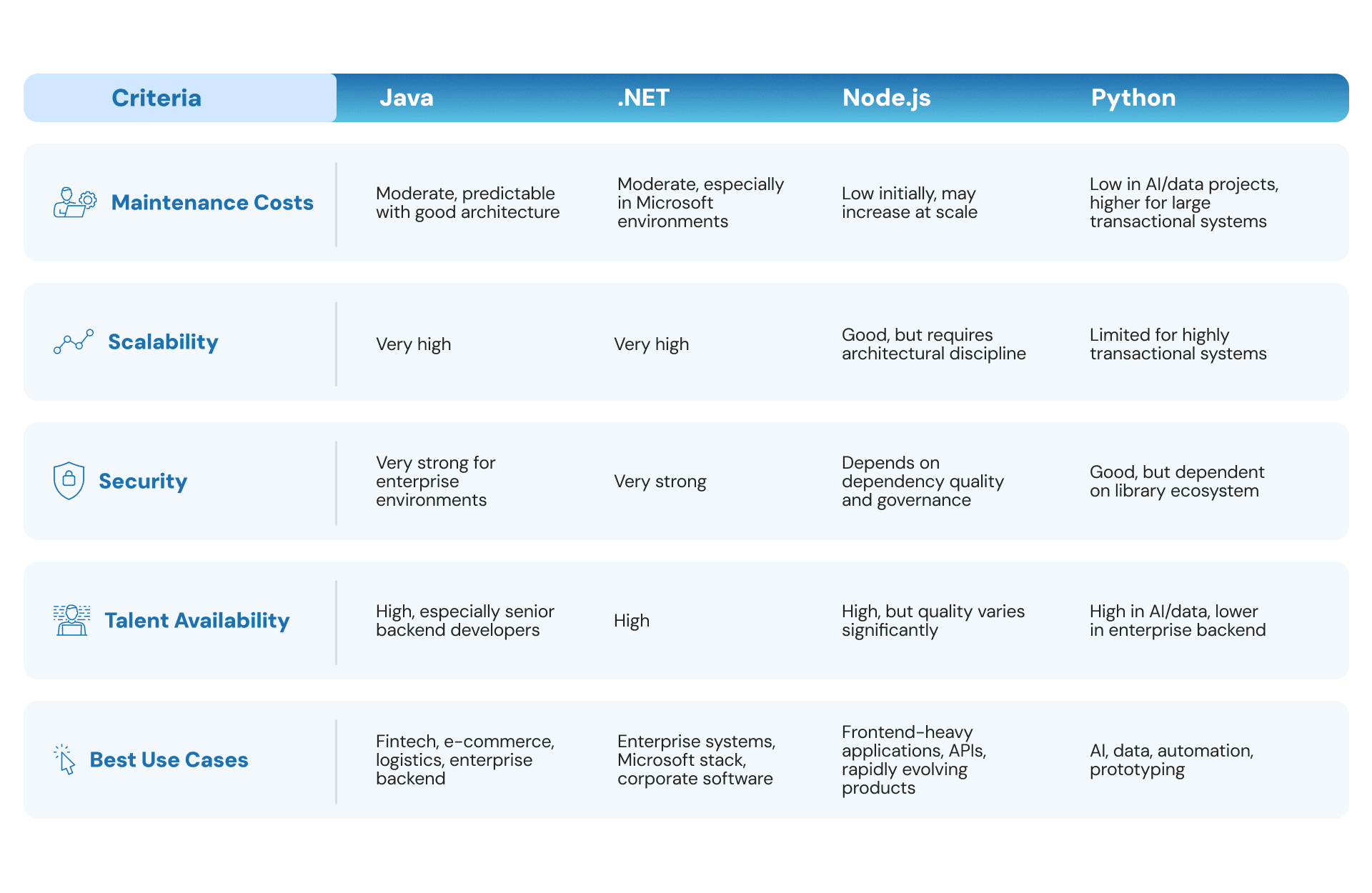
Java vs .NET vs Node.js vs Python – Which Technology Should You Choose for an Enterprise System?
JAVA BUSINESS FIT Framework – How to Assess Whether Java Fits Your Business?
JAVA BUSINESS FIT is a practical framework for assessing whether Java is the right choice for an organization.The Most Important Evaluation Criteria:
J – Journey Criticality: does the system support business-critical processes?
A – Architecture Complexity: does the system require complex domain logic?
V – Volume and Scalability: will the system handle large volumes of data or users?
A – Availability of Talent: does the company have access to Java developers?
B – Business Continuity: does the system need to operate for many years?
U – Upgrade Path: is there a migration and development path?
S – Security and Compliance:is the system subject to regulations?
I – Integration Landscape: does the application integrate with ERP, CRM, payments or external systems?
N – Non-Functional Requirements: do the requirements include performance, monitoring, SLA and disaster recovery?
E – Engineering Maturity: does the organization have CI/CD, testing, observability and ownership?
S – Strategic Fit: does Java support the business strategy, or does it only “fit technically”?
S – Sustainability of Costs: will the maintenance cost remain acceptable over the next 3–5 years?
CTO Checklist Before Choosing or Modernizing Java
This checklist helps CTOs quickly assess whether the organization is prepared to build, maintain or modernize a Java system and identify areas that may generate additional costs, technology risks or scalability issues.
Download the PDF version and go through the assessment together with your architecture team and technical leaders.
How Can Edge One Solutions Help Organizations Using Java?
Edge One Solutions supports organizations that develop, maintain or modernize Java systems without increasing business risk.
- Java Architecture Audits – we help assess the state of the system, the level of technical debt, security risks, maintenance costs and the realistic modernization path.
- Legacy System Modernization – we support migrations from older Java versions, monolith modularization, refactoring of critical components and maintainability improvements.
- Java Team Support – we provide senior Java, backend, DevOps and architecture consulting capabilities where resources or experience are missing.
- Java Development – we design and develop backend applications, integration systems, APIs, microservices and business platforms.
- DevOps and Platform Engineering – we help organize CI/CD, containerization, Kubernetes, monitoring, logging and the release process.
- AI Integrations – we support the integration of Java applications with LLMs, RAG, AI agents and business process automation.
- Cloud Migration – we help move Java applications to the cloud while controlling cost, performance and operational risk.
Summary
Enterprise Java is a decision about product development predictability, maintenance costs, talent availability and the level of technology risk. For CTOs, the key consideration is whether Java can support the safe evolution of a system that is expected to operate for many years. Java is particularly strong where the system supports business-critical processes, requires high availability, integrates multiple data sources and must be developed by several teams.
What Should a CTO Do Before Deciding to Build or Modernize a Java System?
A CTO should conduct a business and technology assessment: calculate the cost of ownership, map architectural risks, evaluate talent availability, assess the level of technical debt and compare Java with alternatives over a 3–5 year product development horizon.
FAQ
Does Java still make sense in 2026?
Yes, especially for enterprise systems that require stability, security and a long lifecycle.
Is Java a good choice for large organizations?
Yes. Java works well in large organizations because it has a mature ecosystem, a broad talent market and stable tools for building highly available systems.
Is Java suitable for AI?
Yes, but not always as the main technology for training models. Java works well for integrating AI with existing business systems, for example through APIs, RAG, workflow automation and Spring AI.
Is Java expensive to maintain?
Java itself is not expensive — poorly designed Java systems are. Maintenance costs depend on architecture, testing, automation, platform version, code quality and the level of technical debt.
Is it worth modernizing legacy Java?
Yes, if the system still supports important business processes. Modernization is often safer and cheaper than a full system rewrite. The key is to start with an audit and a risk map.
How can technical debt be reduced in a Java system?
First, it needs to be measured: architecture, dependencies, tests, vulnerabilities, deployment and code quality. Only then should refactoring, version migrations and modularization be planned.
Does Java work well in the cloud?
Yes, but it requires the right approach to containerization, JVM configuration, observability and infrastructure costs. Java works well in the cloud when the architecture is prepared for scaling and automation.