
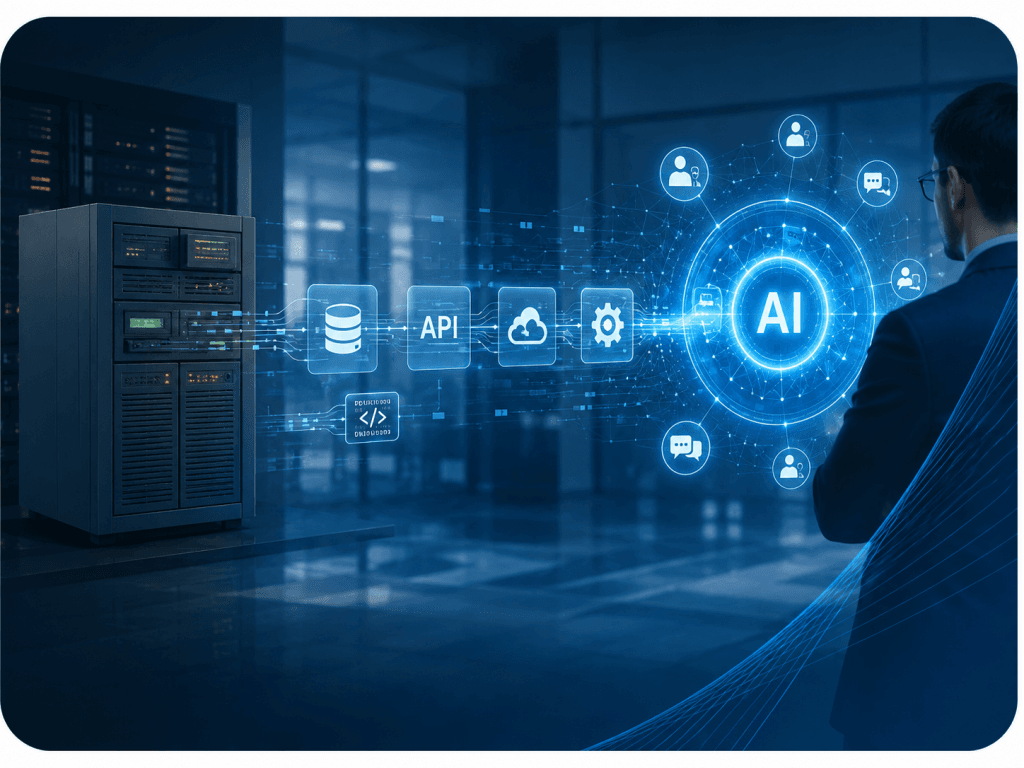
A company wants to add an AI model to a system that has supported orders, settlements, manufacturing, claims, or customer operations for many years. During a workshop, the idea sounds straightforward: the model should retrieve information, recommend the next action, or automate selected tasks. The real difficulty appears when the team tries to connect AI to the production environment.
The system has no stable API. Data is fragmented across databases, files, and manually maintained registers. Documentation no longer reflects the actual business logic. Tests do not protect critical workflows, and every release still depends on a small number of people who understand the hidden relationships between modules.
In this environment, model selection is not the main problem. The main problem is that the system was not designed for controlled AI access, continuous data exchange, or machine-initiated operations.
This guide explains how to approach legacy system modernization for AI without automatically rebuilding the entire application. It shows when an integration layer is sufficient, when selected refactoring or rearchitecture is necessary, how to prepare APIs, data, tests, security, and observability, and how to modernize the system without freezing the product roadmap.
What is legacy system modernization for AI?
Definition: legacy system modernization for AI is the process of improving architecture, data, integrations, testing, security, and operations so that an AI model or agent can use the system in a controlled, measurable, and maintainable way.
This does not mean that every older application has to move to the cloud, be split into microservices, or be rewritten from scratch. A system is not legacy simply because of its age. It becomes a business constraint when its architecture, technology, or operating model can no longer support current requirements safely and predictably.
From an AI integration perspective, the key questions are:
- Can the system provide the right data at the right time and in a reliable format?
- Is the business logic understood well enough to expose it safely?
- Can operations be called through stable and controlled interfaces?
- Are permissions enforced outside the AI model?
- Do tests confirm that changes will not break critical workflows?
- Can the organization observe model, integration, and system behaviour after deployment?
- Can the process fall back to a manual path or roll back a failed change?
If the answer to most of these questions is no, adding AI will increase the number of dependencies and failure modes. It will not turn the environment into a modern digital platform.
Why is a working legacy system not automatically AI-ready?
A system may support business operations reliably for years and still be unsuitable for direct integration with a model or agent. Traditional enterprise systems were usually designed for deterministic transactions, predefined user interfaces, batch processing, and manual approvals. AI solutions often work with unstructured information, probabilistic outputs, dynamic context, and multiple tools or external services.
| Area | The system may work when… | AI integration additionally requires… |
|---|---|---|
| Data | Experienced users know where to find information and how to interpret exceptions. | Authoritative sources, metadata, quality controls, freshness rules, and permission-aware access. |
| Integrations | File exchange or overnight batch processing is sufficient. | Stable APIs, events, or a controlled mediation layer. |
| Permissions | A human acts through the existing interface and approves each operation. | Authorization for every action performed through a model, tool, or agent. |
| Testing | The team manually verifies critical paths before a release. | Regression, contract, integration, and AI output quality testing. |
| Monitoring | An issue is discovered after a user reports it. | Tracing of calls, failures, latency, cost, output quality, and executed actions. |
| Documentation | Knowledge remains in the team and supports routine maintenance. | Explicit business rules, exceptions, data definitions, and integration contracts. |
Important: an AI assistant that summarizes documents creates different modernization requirements from an agent that changes an order status, generates a financial document, or initiates a payment. The required depth of modernization should follow the level of responsibility assigned to AI.
Define the role of AI in the process first
Before selecting a model, platform, or target architecture, define exactly what AI is expected to do. This prevents the organization from modernizing more than the use case requires while also avoiding a solution that works only during a controlled demonstration.
| AI role | Example | Legacy system requirements | Risk level |
|---|---|---|---|
| Read and retrieve | Search procedures, case history, or technical documentation. | Controlled export or read-only API, metadata, and source-level permissions. | Low or medium |
| Analyze and recommend | Prioritize tickets, assess risk, or recommend a next step. | Historical data, process context, feedback loops, and output verification. | Medium |
| Prepare an operation | Complete a form or prepare a command that a user approves. | Operational API, parameter validation, preview, and audit trail. | Medium or high |
| Execute automatically | Change data, trigger a workflow, or call another system without immediate human approval. | Strict permissions, business rules outside the model, idempotency, limits, monitoring, and rollback. | High |
A common mistake is moving directly from a simple proof of concept to an autonomous agent. Without a controlled integration boundary, validation, and safe operations, the agent receives broad access to a system whose rules and dependencies may not be fully documented.
7 layers of AI readiness in a legacy system
AI readiness is not a single technical property. It should be assessed layer by layer so that the team modernizes only the components that genuinely block the business use case.
1. Business process and ownership
AI needs a clearly defined place in the process. The organization should know which step it supports, who approves the output, who handles exceptions, and what happens when the AI service is unavailable.
- a named business process owner,
- a measurable business outcome,
- documented standard and exception paths,
- a manual mode or fallback,
- clear responsibility for value and risk.
2. Data and business meaning
A model needs more than access to records. It requires current, understandable, and context-rich data. In legacy environments, the same concept may use several names, while a single field may depend on hidden logic or event order.
- identified systems of record,
- field definitions and interpretation rules,
- quality and completeness controls,
- data freshness requirements,
- sensitive data classification,
- lineage and accountable data owners.
3. Integrations and API contracts
AI should not communicate directly with arbitrarily selected tables or technical interfaces. It needs stable contracts that isolate the model from internal legacy implementation details.
- read and write APIs with explicit scope,
- input and output validation,
- contract versioning,
- rate limits and timeouts,
- error handling and retries,
- backward compatibility controls.
4. Architecture and dependency isolation
The new AI layer should not inherit the entire legacy domain model. A facade, adapter, or anti-corruption layer can translate concepts and protect new components from the constraints of the old system.
5. Testing and safe change
If the application has limited automated testing, modernization should begin by creating a safety net. Characterization, contract, integration, and end-to-end tests may initially provide more value than unit tests for every legacy component.
6. Operations and observability
Production teams need to reconstruct what the model did, which data it used, which API it called, how long the operation took, and what result was stored. Without correlated logs across the model, integration layer, and legacy application, incidents become harder to diagnose than before modernization.
7. Security, permissions, and auditability
The model should never decide whether a user or agent is authorized to execute an operation. Authorization must remain in the business system or a controlled integration layer. The organization should minimize the number of tools available to the agent, the accessible data scope, and the degree of autonomy.
Readiness signal: the organization can describe not only what the agent should do, but also what it must never do, which data it cannot access, and which operations always require human approval.
When is an integration layer enough?
Not every AI initiative justifies deep system reconstruction. An integration layer may be sufficient when the legacy core remains stable, continues to perform its primary business function well, and can be isolated from new components.
An integration layer is a good option when:
- AI primarily needs to read data or prepare recommendations,
- critical transaction logic does not need to change,
- the system has predictable integration points or can be wrapped with an adapter,
- data can be exposed without compromising source integrity,
- the AI solution can operate alongside the legacy application,
- business risk requires gradual deployment,
- the organization needs to validate value before launching a multi-year transformation programme.
What can the architecture look like?
- The legacy system remains the system of record for critical transactions.
- An API layer or adapter exposes only the data and operations required by the use case.
- A translation layer maps legacy terms and formats to a new domain model.
- The AI service uses only approved interfaces.
- Every write operation passes deterministic validation and standard authorization.
- Logs and correlation identifiers make the complete decision path traceable.
Example: an AI assistant supporting contact-centre employees does not need direct access to the CRM database. It can use an API that returns the customer history, current case status, and allowed next actions. The legacy application remains unchanged, while the new layer controls the data and operations available to AI.
When does the integration layer become another form of technical debt?
An adapter will not solve the problem if it has to reproduce hundreds of exceptions, compensate for inconsistent data, and implement transaction controls that the legacy system itself lacks. Once the integration layer starts becoming the real owner of business logic, selected modules need refactoring or the system boundaries need to be redesigned.
When do you need refactoring or rearchitecture?
Refactoring becomes necessary when the problem is not simply the lack of a modern interface, but the internal construction of the application. This is common when business rules, data access, and technical operations are tightly coupled.
Refactoring selected modules is justified when:
- a stable API contract cannot be separated from internal implementation details,
- a change in one module has unpredictable effects across the application,
- business logic is duplicated in application code, database procedures, and the user interface,
- read and write operations cannot be isolated,
- insufficient testing prevents safe integration development,
- current performance cannot support the AI use case,
- permissions cannot be enforced consistently for a new access channel.
Replatforming may be enough when:
- the main constraint is an unsupported runtime or infrastructure platform,
- the application needs standardised environments, containerisation, or deployment automation,
- business logic is stable but operating and scaling the application is too expensive,
- the system requires modern monitoring, configuration management, backup, or disaster recovery.
Rearchitecture is justified when:
- AI will become part of multiple processes and products rather than one isolated feature,
- the system needs events or data close to real time,
- business domains must evolve and scale independently,
- the current environment cannot meet security, resilience, or availability requirements,
- the continuing cost of legacy constraints exceeds the cost of incremental transformation.
Important: a complete rewrite is one possible strategy, but it should not be the default. Incremental modernization is usually safer because old and new components can coexist while the organization verifies behaviour and business value.
How do you choose a modernization strategy?
The decision should not be driven by the engineering team’s preferred technology. It should compare process criticality, application condition, expected change frequency, data quality, operational risk, and the intended role of AI.
| Strategy | When to use it | Main benefit | Main risk |
|---|---|---|---|
| API wrapper or facade | The core is stable and AI needs limited access to data or functions. | Fast isolation of the new AI layer from legacy internals. | Too much business logic moves into the adapter. |
| Anti-corruption layer | Old and new solutions use different data models and business terminology. | The new architecture avoids inheriting legacy concepts and constraints. | Mapping complexity grows over time. |
| Strangler Fig | Capabilities can be extracted and traffic gradually redirected to new services. | Lower migration risk and continued business operations. | A longer period of operating two solutions. |
| Branch by Abstraction | The component sits deep inside a monolith and has many callers. | Old and new implementations can run behind one abstraction. | Requires changes to the legacy code and strong test coverage. |
| Event-driven integration | AI needs information about business changes without continuously querying the source system. | Looser coupling and near-real-time processing. | Ordering, consistency, duplicates, and replay must be managed. |
| Refactor or rearchitecture | Constraints lie in business logic and system boundaries, not only interfaces. | Long-term improvement in changeability, testability, and integration. | Higher scope, cost, and delivery risk. |
| Replace | The system is unsupported, insecure, or no longer economically viable. | Removes constraints that cannot be rationally repaired. | Hidden business logic and migration risk may be underestimated. |
A modernization programme can combine several strategies. One module may be wrapped with an API, another gradually extracted, and a third deliberately left unchanged because it does not affect the AI use case.
How do you prepare data and business knowledge?
Legacy data may be technically accessible but still unsuitable for AI. The challenge is often not only record quality, but inconsistent meaning, hidden dependencies, and missing ownership.
1. Identify the authoritative source
If the same information appears in a CRM, data warehouse, and operational spreadsheet, the team must decide which source is binding. The model should not resolve conflicts between systems on its own.
2. Map business semantics
A field called “status” may describe a technical, operational, financial, or customer-facing state. Without a shared glossary, AI may produce a linguistically plausible answer that is wrong in the actual business context.
3. Separate operational data from knowledge content
Transactions, documents, procedures, and work instructions require different access paths. A vector database may support document retrieval, but it should not replace the transaction system as the system of record.
4. Define freshness requirements
Not every use case requires real-time data. Periodic synchronisation may be sufficient for management reporting. An agent supporting customer service or inventory decisions may need current state, explicit timestamps, and rules for handling stale data.
5. Establish data contracts
A data contract should define fields, types, meaning, quality expectations, update frequency, and ownership. It reduces the risk that a silent change in the source system will degrade AI quality without triggering a technical failure.
Practical rule: AI should know whether a piece of information is missing, uncertain, outdated, or inconsistent. Treating all available data as equally reliable creates confident but operationally unsafe outputs.
How do you connect an AI agent to a legacy system safely?
An AI agent becomes significantly more risky when it can execute actions rather than only retrieve or summarize information. The safe design principle is to give the model access to a small set of purpose-built tools instead of broad technical access to the application.
Safe integration principles
- Least privilege: expose only the data and functions necessary for the use case.
- Authorization outside the model: every operation must be checked against the user, role, business context, and current system state.
- Deterministic validation: parameters, limits, and business constraints must be enforced by code.
- Idempotency: repeated calls must not create duplicate financial, operational, or customer actions.
- Human approval: high-impact, irreversible, or regulated operations should require explicit confirmation.
- Audit trail: record the user request, model decision, tool call, input parameters, validation result, and final system response.
- Rate and cost limits: restrict the number, value, or frequency of operations.
- Fallback: the business process must continue when the AI service or dependent model is unavailable.
| Operation type | Control | Example |
|---|---|---|
| Low-risk read | Automatic, subject to the user’s existing permissions | Retrieve a service request status |
| Prepare a change | Preview and user approval | Complete a form or draft a response |
| Reversible change | Rules, limits, logging, and rollback | Change a ticket priority |
| Critical operation | Mandatory approval and additional authorization | Approve a payment or delete a record |
How do you test the legacy system and AI as one solution?
Traditional application testing is not sufficient, but it also cannot be replaced by prompt testing. A production solution combines the model, data, integration layer, APIs, deterministic rules, and the existing application. The complete path has to be verified.
Legacy system testing
- characterization tests that preserve current behaviour,
- regression tests for critical business workflows,
- API contract testing,
- integration and transaction testing,
- performance, resilience, and recovery testing,
- data migration and compatibility testing.
AI layer testing
- a reference dataset with expected results,
- evaluation of correctness, completeness, and policy compliance,
- tests for missing, stale, or contradictory context,
- hallucination and unsupported inference tests,
- prompt injection and tool misuse tests,
- permission, confidentiality, and data filtering tests,
- latency, availability, and cost threshold tests.
End-to-end process testing
The most important test verifies whether the business process reaches the correct outcome. A model can generate a valid recommendation while the integration assigns it to the wrong customer record or repeats the operation. The test should therefore cover the user request, data retrieval, model output, deterministic validation, legacy API call, and final stored result.
Important: AI testing is not limited to checking whether the answer is correct. It must also verify whether the complete system responds safely to an incomplete, ambiguous, manipulated, or incorrect answer.
How do you modernize without stopping delivery?
Most organizations cannot freeze the product roadmap while modernizing a core application. The system still supports customers, regulations, revenue, and daily operations. Modernization therefore has to remove architectural constraints while ongoing product development continues.
1. Modernize by business capability
Instead of rebuilding every technical layer, select one process or capability required by the AI use case. This reduces dependencies and creates a shorter route to measurable value.
2. Maintain two synchronized backlogs
- a business and product backlog,
- a modernization and risk-reduction backlog.
Both backlogs should be planned together. If modernization remains invisible work performed only when the team has spare time, it will repeatedly lose to urgent feature requests.
3. Release behind controlled switches
Feature flags, routing rules, and gradual activation allow the organization to direct limited traffic to a modernized component and return to the previous path quickly when necessary.
4. Run old and new paths in parallel
For a defined period, the old and new mechanisms can process the same inputs while only one writes the production result. Comparing outcomes helps identify behavioural differences before a full cutover.
5. Define the retirement plan
Coexistence is a transition stage, not a target operating model. Every extracted capability should have an owner, exit criteria, and a date or condition for removing the previous path.
| Principle | Practical application | Outcome |
|---|---|---|
| Small change boundaries | Modernize one process or module | Lower risk and faster validation |
| Continuous integration | Automated builds, tests, and deployment | Fewer large releases that are difficult to reverse |
| Parallel execution | Compare results from old and new components | Behavioural verification before cutover |
| Gradual traffic | Launch for a limited user group, process, or region | Controlled production impact |
How do you measure risk and prioritize modernization?
Not every legacy issue is equally urgent. Priority should follow the impact on the AI use case and the business process, not the age or perceived attractiveness of the technology.
Assess each area across five dimensions
- Business criticality: what is the impact of an error or outage?
- Change exposure: how often will the module need to evolve?
- Integration difficulty: is there a stable interface and reliable documentation?
- Security and compliance: which data, decisions, and regulated processes are involved?
- Reversibility: can the change be withdrawn quickly and the previous process restored?
A highly critical module with frequent changes and poor reversibility should be stabilized before an agent receives write access. A document archive used only for retrieval may be exposed through a controlled read layer without deep reconstruction.
Rule: modernize first where a constraint blocks a specific business outcome or creates unacceptable risk. Do not begin with a component simply because its technology appears oldest.
A legacy modernization plan for AI
Stage 1: assess the system and AI use case
- map the business process and accountable owners,
- define the responsibility and autonomy of AI,
- map applications, data, and integrations,
- assess code, architecture, security, delivery, and operations,
- identify constraints that block production deployment.
Outcome: a decision on which components remain, which require isolation, and which require modernization.
Stage 2: stabilize the application and build a safety net
- characterization and regression tests,
- monitoring of critical workflows,
- automated builds and deployments,
- controlled access, secrets, and configuration,
- minimum viable architecture and flow documentation.
Outcome: the team can introduce further changes with controlled risk.
Stage 3: create the integration boundary
- API, adapter, or anti-corruption layer,
- data and operation contracts,
- authorization, limits, and validation,
- error handling, retries, and idempotency,
- central logging and request correlation.
Outcome: AI uses a stable surface instead of internal legacy mechanisms.
Stage 4: run a limited AI pilot
- one process and a limited user group,
- start with read or recommendation capabilities,
- use a reference dataset and explicit quality metrics,
- monitor costs and user behaviour,
- collect errors, ambiguous cases, and rejected recommendations.
Outcome: value is validated without extending risk across the full system.
Stage 5: harden for production
- security, performance, and resilience testing,
- incident management procedures,
- fallback, rollback, and manual operating modes,
- SLA, ownership, and escalation paths,
- monitoring of quality, cost, integrations, and business outcomes.
Outcome: the solution can become part of the real operating process.
Stage 6: modernize additional capabilities incrementally
After the first use case demonstrates value, additional components can be extracted, refactored, replatformed, or replaced according to the roadmap. Not every module needs to change. Scope should follow product needs and the cost of maintaining existing constraints.
Common company mistakes
1. Adding a chatbot without redesigning the process
The interface looks modern, but users still copy information manually between systems. AI adds another screen instead of reducing process time or operational effort.
2. Giving the model direct access to a legacy database
This creates tight coupling, unclear permission boundaries, and uncontrolled interpretation of internal data structures. AI should consume explicit contracts, not the source system’s implementation.
3. Trying to hide data problems behind the model
AI does not automatically resolve duplicates, contradictory definitions, missing lineage, or unclear ownership. It can make the issue less visible until an incorrect recommendation reaches a customer or operational process.
4. Granting write access too early
The organization starts with autonomy before building deterministic validation, limits, approval, audit, and recovery. A safer sequence is read, recommend, prepare, and only then execute under controlled conditions.
5. Modernizing everything before validating the use case
A multi-year transformation can consume significant budget before the organization proves that AI solves the selected problem and produces measurable value.
6. Rebuilding the system as a big-bang programme
A large replacement increases the risk of losing hidden business rules, delays value, and makes ongoing product development harder to protect.
7. Refactoring before building tests
The team changes the system without a reliable way to confirm behavioural equivalence. Every release becomes a production experiment.
8. Splitting responsibility between disconnected teams
The AI team owns the model, the application team owns the legacy system, and integration falls between them. When the process fails, each group can demonstrate that its own component worked as designed.
Checklist for CIOs and CTOs
Use case and responsibility
- AI has a clearly defined task and operating boundary.
- A business process owner has been assigned.
- Decisions requiring human involvement are documented.
- A manual mode and fallback are available.
Data
- Systems of record have been identified.
- The meaning of critical fields and business terms is documented.
- Quality and freshness requirements are defined.
- Sensitive data is classified and protected.
- Data changes have an owner and a contract.
Integrations and architecture
- AI does not use arbitrary tables or internal interfaces directly.
- A stable, versioned API or adapter is available.
- Validation and authorization operate outside the model.
- Write operations are restricted, auditable, and reversible where possible.
- The modernization approach has been selected: wrapper, refactor, Strangler Fig, replatform, or replace.
Quality and security
- Critical legacy behaviour is protected by tests.
- Contract and integration tests are in place.
- A reference dataset exists for AI evaluation.
- Prompt injection, tool misuse, and data leakage have been tested.
- The change can be rolled back safely.
Operations
- Logs connect the user, model, integration, and final operation.
- Quality, failures, latency, and costs are monitored.
- SLA, alerts, and escalation paths are defined.
- The modernization roadmap does not stop ongoing delivery.
- Every stage has completion criteria and a continue, redesign, or stop decision.
How can Edge One Solutions help?
Preparing a legacy system for AI requires capabilities that are often distributed across separate teams: business and architecture analysis, software development, system integration, data engineering, quality assurance, DevOps, security, and production AI operations.
Edge One Solutions can support organizations through:
- application, architecture, data, and integration assessments,
- discovery and selection of an AI use case,
- API, adapter, and integration-layer design,
- incremental application refactoring and modernization,
- custom software development,
- development and integration of AI solutions for business,
- data pipelines and Data & Analytics,
- test automation and quality assurance,
- CI/CD, cloud infrastructure, monitoring, and DevOps services,
- a dedicated team responsible for a selected modernization stream.
Edge One Solutions perspective: the purpose of modernization is not to replace technology for its own sake. It is to create an environment in which the organization can develop the product safely, integrate new capabilities, and maintain the solution without depending on individual experts or manual processes.
Before starting, it is also worth assessing your organisation’s AI implementation readiness and understanding why AI initiatives stall between PoC and production. When the main challenge is understanding and stabilising the existing codebase, see our guide to working with legacy code.
A practical modernization example is the CoSafe crisis-management application case study, where legacy components were modernized, the backend moved toward a modular architecture, and end-to-end tests reduced delivery risk.
Summary
A legacy system does not have to be rebuilt completely before the organization can use AI. It does, however, need a safe integration boundary, reliable data, explicit business rules, adequate testing, and an operating environment that makes AI behaviour observable and controllable.
The most important decisions concern the complete business and technology process:
- What level of responsibility should AI receive?
- Which data and operations should be exposed?
- When is an adapter or API sufficient?
- Which modules genuinely require refactoring?
- How can the product roadmap continue during modernization?
- How should the model, integration, and legacy application be tested together?
- When should the organization continue, redesign, or stop the initiative?
Effective modernization starts with a limited business problem and ends with a solution that can be operated, changed, and scaled safely. It does not start with selecting the newest technology.
Sources and architecture standards
When planning legacy modernization and AI integration, the following recognised patterns and standards provide useful reference points: