Body leasing in IT is a flexible cooperation model in which a company does not hire a specialist as a full-time employee but instead “rents” their time and expertise from an external provider. In practice, this means that the specialist formally remains an employee or contractor of the IT staffing provider but performs daily tasks for the client – often as part of the client’s project team, using their tools and processes.
This solution allows companies to quickly fill skill gaps in their teams, for example, when they need an experienced Java developer, data analyst, or DevOps engineer for the duration of the project. Unlike classic outsourcing, body leasing does not cover the entire project or its outcome – the client manages the tasks and is responsible for the final result. This is why body leasing is often confused with team augmentation – the expansion of a team with external experts. In practice, the two terms are often used interchangeably, though they differ in the scale of cooperation.
Responsibility Model: Service, Not Result
Jednym z najczęstszych nieporozumień przy body leasingu jest założenie, że dostawca odpowiada za efekt pracy specjalisty. Tymczasem body leasing to umowa o świadczenie usług, a nie o dzieło — oznacza to, że usługodawca zapewnia dostępność specjalisty o określonych kompetencjach, natomiast pełna odpowiedzialność za rezultat projektu spoczywa na kliencie.
One of the most common misconceptions about body leasing is the assumption that the provider is responsible for the outcome of the specialist’s work. In fact, body leasing is a service agreement, not a work-for-hire contract – which means that the provider ensures the availability of a specialist with specific competencies, while full responsibility for the project’s results lies with the client.
In practice, the provider is responsible for making sure that the specialist is available, works under the agreed conditions, and has the declared qualifications. However, the provider is not liable for project errors or delays resulting from the client’s decisions or internal organization. That’s why it’s crucial to clearly state in the contract that the collaboration is body leasing (a service), not full project outsourcing. In broader models such as team leasing or team augmentation, the boundary may blur—but even then, the supervision and accountability for results usually remain on the client’s side.
Verifying Competencies and Specialist Replacement
When signing a body leasing agreement, it’s worth agreeing upfront on how the specialist’s skills will be verified. In the IT industry, the standard approach involves a technical interview with the client’s team or a short test task—this helps assess both technical skills and soft aspects like communication and cultural fit.
Dobrym rozwiązaniem jest również wprowadzenie do umowy zapisu o możliwości podmiany specjalisty, jeśli jego kompetencje lub zaangażowanie nie spełniają oczekiwań. W profesjonalnych kontraktach pojawia się zwykle termin (np. 5–10 dni roboczych) na przedstawienie kandydata zastępczego o porównywalnych kwalifikacjach. Taka klauzula chroni interes obu stron – klient ma gwarancję ciągłości projektu, a dostawca zachowuje elastyczność w doborze zasobów.
It’s also a good practice to include a clause allowing for the replacement of the specialist if their skills or engagement do not meet expectations. Professional contracts typically define a timeframe (e.g., 5-10 business days) for presenting a replacement candidate with comparable qualifications. Such a clause protects both parties – the client secures project continuity, whilethe provider retains flexibility in resource allocation.
It’s also important to determine who approves the new specialist and what the onboarding process looks like after the replacement. This minimizes downtime and helps maintain project momentum.
Service Conditions: Availability, Tools, Timesheets/MD
Jednym z kluczowych elementów umowy body leasingowej są zapisy dotyczące dostępności specjalisty i organizacji jego pracy. Już na starcie warto ustalić, czy specjalista będzie pracować zdalnie, hybrydowo, czy w biurze klienta oraz kto zapewnia sprzęt i dostęp do narzędzi projektowych. W praktyce najczęściej to klient udostępnia środowisko pracy – konta w systemach (np. Jira, GitLab, VPN) oraz dostęp do dokumentacji projektowej.
One of the key parts of a body leasing agreement is the section covering the specialist’s availability and work organization. At the outset, it’s essential to agree on whether the specialist will work remotely, in a hybrid mode, or on-site at the client’s office, and who provides the equipment and access to project tools. In practice, clients usually provide the work environment – accounts in systems (e.g., Jira, GitLab, VPN) and access to project documentation.
Billing is typically based on the time & material model, meaning the actual time worked. Therefore, timesheets or man-day (MD) reports are crucial—they confirm the number of hours worked during a given period. These reports form the basis for invoicing and serve as a tool for tracking project progress and costs. It’s advisable to specify in the contract which system is used for reporting (client’s or provider’s), who approves the hours, and within what timeframe.
A well-drafted contract should also define the maximum number of monthly hours and the rules for handling overtime or unavailability. Clear terms in this area prevent misunderstandings and allow for better project budgeting.
Confidentiality (NDA), Personal Data (GDPR), and System Access
In the body leasing model, specialists often gain access to source code, production systems, or customer data. Therefore, a non-disclosure agreement (NDA) is a critical part of the contract. This document should clearly define what information is considered confidential, how long confidentiality obligations apply, and what penalties apply for breaching trade secrets.
If the specialist will access personal data, a data processing agreement compliant with GDPR must also be included. This ensures protection for both parties by clearly defining who is the data controller and who is the data processor. In practice, this often includes assigning appropriate permissions, maintaining a registry of authorized individuals, and applying the principle of minimal access.
It’s worth preparing an internal security checklist, covering tasks such as account creation, VPN access, repository and messenger policies. Such preparation protects the organization from data leaks and facilitates IT security audits.
Copyright: The Transfer Chain
Intellectual property rights are one of the most sensitive parts of a body leasing agreement. Although the specialist performs tasks for the client, they are formally employed or contracted by the IT service provider. Therefore, it’s crucial to clearly define the chain of copyright transfer – from the specialist, through the provider, to the end client.
The most common solution is a two-step transfer:
- The specialist transfers the proprietary rights to the works created (e.g., code, documentation, UX/UI designs) to their employer.
- The provider then transfers those rights to the client – within a defined scope and on agreed fields of exploitation.
The contract should specify the moment of rights transfer – usually upon acceptance of the work or payment of the invoice. It’s also worth clarifying licensing issues, especially in long-term projects where the specialist may use their own libraries or code fragments. This ensures that the client holds full rights to the deliverables while the provider protects their know-how.
Costs, Protective Clauses and Termination Flexibility
A transparent billing model is the foundation of successful body leasing cooperation. The contract should detail the hourly or daily rate, invoicing rules, and payment terms. It should also specify how unused hours or overtime are handled – whether they are billed in the next period or expire. Such clarity prevents disputes and helps manage project costs effectively.
Protective clauses are equally important to secure both parties’ interests. For example, an anti-poaching clause protects the provider from situations where the client attempts to hire the consultant directly after cooperation ends. Conversely, the client may request penalties for unjustified delays in specialist delivery or service interruptions.
Termination flexibility is also key—the contract should include a reasonable notice period (e.g., 14 or 30 days) and allow early termination in justified cases, such as project changes, funding loss, or provider issues. Well-defined termination terms protect the relationship and enable a smooth, conflict-free conclusion.
Onboarding and Integration — A Practical Checklist for Clients
The contract is only half the success. To ensure smooth cooperation in the body leasing model, clients should provide effective onboarding – both formal and organizational. The first step should be completing all necessary documents: the service agreement, NDA, data processing agreement, and copyright clauses. At the same time, it’s wise to confirm rates, billing model, and specialist availability.
The second part of the onboarding checklist concerns technical and integration aspects. The client should prepare access to tools (project systems, code repositories, VPN, email), assign an onboarding mentor, and inform the team about the new member’s arrival. Proper onboarding boosts efficiency from day one, shortens adaptation time, and improves communication between teams.
From the provider’s perspective, it’s important to monitor the first weeks of the specialist’s work and address any technical or organizational issues promptly. A well-prepared onboarding process ensures that body leasing is not just a formal staffing solution but a real project support mechanism.
Summary
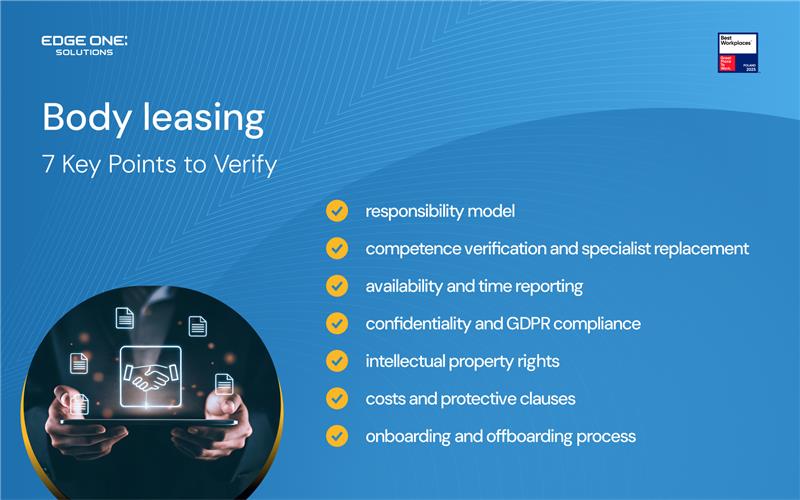
Body leasing in IT is a flexible and efficient way to strengthen your team – but only a well-structured contract guarantees security and effective cooperation. Before signing, go through this 7-point checklist:
- Do you understand the responsibility model – service, not result?
- Have you verified the specialist’s competencies and secured a replacement option?
- Are the terms of availability, tools, and time reporting clearly defined?
- Do the NDA and GDPR agreements protect your data and confidentiality?
- Is the copyright transfer fully regulated along the entire chain?
- Is the billing model transparent and supported by protective clauses?
- Do you have an onboarding plan and termination procedure in place?
Following these points will help you avoid common mistakes and misunderstandings that often occur between clients and IT service providers. When legally and organizationally well-prepared, body leasing can become not only a convenient staffing model but also an effective tool for supporting growth and scaling technology projects.