Development of an Automotive Parts and Accessories Marketplace for Motorro - Edge1S
Development of an Automotive Parts and Accessories Marketplace for Motorro

Motorro case study laptop mockup

Project at a glance

Client: MotorroIndustry: Automotive & e-CommerceService:SoW / Fixed PriceArea: Marketplace / e-Commerce / Automotive

Edge One Solutions supported Motorro by delivering the project in the SoW / Fixed Price model, creating a scalable marketplace platform for the automotive industry that connects manufacturers, suppliers, and wholesalers of automotive parts and accessories.

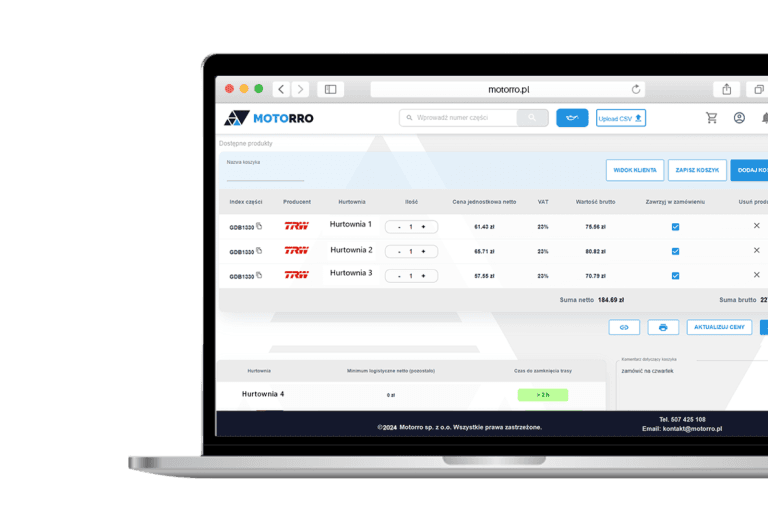
The solution enables customers to purchase products from multiple suppliers within a single shopping cart, verify product availability in real time, check estimated delivery times, and benefits from a scalable architecture designed to support the platform's continued growth and performance.
Tools and technologies used

  • Challenge

    Motorro needed a scalable and intuitive solution that would connect multiple suppliers within one system. The key goal was to create a platform that makes it easier for users to purchase automotive parts and accessories while providing access to up-to-date information about products and deliveries.

    The main challenge was organizing the purchasing process in a multi-supplier environment. Users needed to be able to find the required products, add them to one cart, and complete the purchase without having to manage separate processes for each supplier.

    The project also required integration with wholesalers of automotive parts and accessories. In practice, this meant handling product data, availability, suppliers, and delivery times in a consistent, clear, and useful way for the end customer.

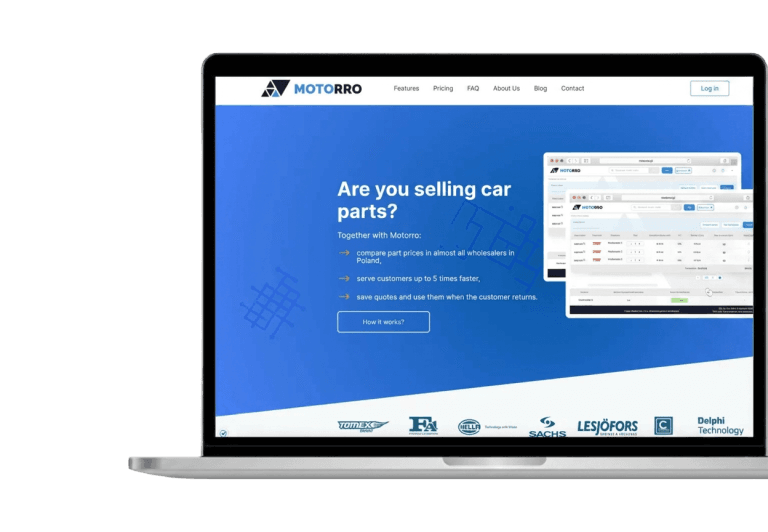
    Motorro case study laptop illustration showing Motorro website
  • Scope of work by Edge One Solutions

    Edge One Solutions was responsible for building a marketplace platform supporting the sale of automotive parts and accessories in a multi-supplier model. The work included both application development and integrations required to support suppliers and product data.

    The scope of work included:

    · development of a marketplace for the automotive industry,
    · backend development in Java,
    · frontend development using React,
    · preparation of a web interface based on HTML5,
    · integration of multiple manufacturers and suppliers,
    · integration with wholesalers of automotive parts and accessories,
    · support for purchases from multiple suppliers within one cart,
    · implementation of a product availability checking mechanism,
    · support for estimated delivery time information,
    · preparation of an architecture ready for further scaling.

    Motorro laptop case study mockup eng
  • Results

    Motorro needed a scalable and intuitive solution that would connect multiple suppliers within one system. The key goal was to create a platform that makes it easier for users to purchase automotive parts and accessories while providing access to up-to-date information about products and deliveries.

    The main challenge was organizing the purchasing process in a multi-supplier environment. Users needed to be able to find the required products, add them to one cart, and complete the purchase without having to manage separate processes for each supplier.

    The project also required integration with wholesalers of automotive parts and accessories. In practice, this meant handling product data, availability, suppliers, and delivery times in a consistent, clear, and useful way for the end customer.

    Motorro case study laptop illutration showing Motorro website
  • Project significance for the Automotive and e-Commerce sector

    Automotive marketplaces must combine the convenience of online shopping with the complexity of product data, suppliers, and stock availability. In the case of automotive parts and accessories, users expect not only a wide product range, but also accurate information about availability and expected delivery time.

    In projects of this type, API integrations, stable backend architecture, a clear frontend, and a well-designed purchasing process are especially important. The more suppliers a platform supports, the more important data consistency, cart management, and process predictability become.

    For automotive companies, marketplace development can be a way to scale sales, expand the product offering, and create a single digital access point to products from multiple partners.

    Digital retail and e-commerce technology illustration representing connected commerce and logistics.

Entrust your project to our experts!

Fill out the form
AI System Testing: How to Test LLMs, RAG and AI Agents Before Production

How do you test AI systems before production? Explore QA for LLMs, RAG and AI agents: retrieval, output quality, security, regression and monitoring....  read more

Data Readiness for AI: 12 Questions to Ask Before Choosing a Model

Is your data ready for AI? Explore 12 questions on quality, ownership, lineage, integrations, freshness, pipelines, access control and maintenance costs....  read more

EU AI Act from 2 August 2026: What Changes for Businesses and How to Prepare AI Systems?

What does the EU AI Act change in practice for businesses using AI? We look at how the new requirements may affect applications, architecture, data, UX, QA and monitoring, and where to start a technical review of your AI system....  read more