

We know it’s worth looking after our health. We know that finding many illnesses early gives us a better chance of treating them successfully. And yet months, sometimes years, can go by before we book a screening appointment. Why do we put it off? Is it really just a matter of finding the time?
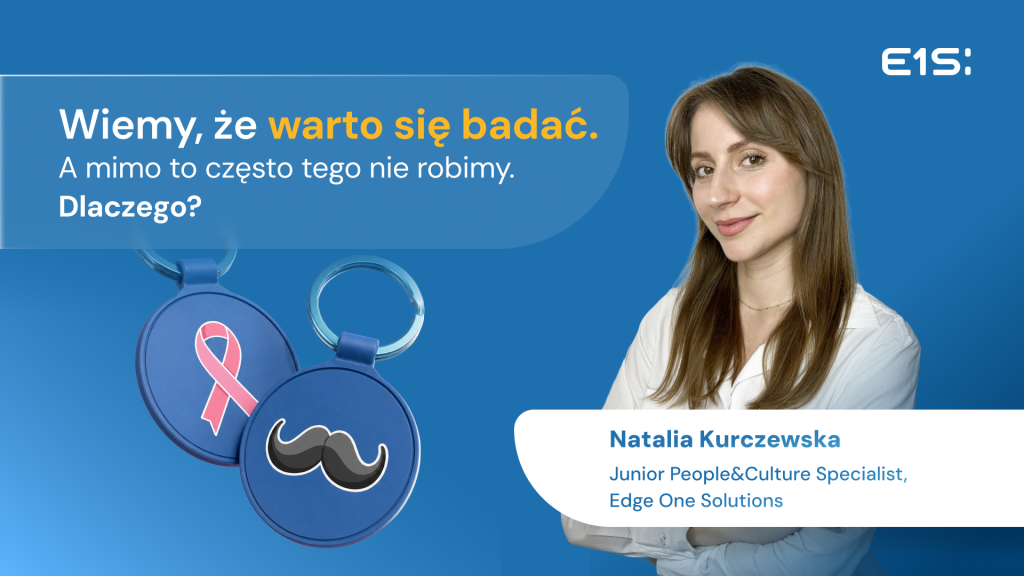
The pink ribbon and the moustache are conversation starters
This year at Edge1S, we wanted to mark Breast Cancer Awareness Month and Movember with something people could use. Everyone could pick up two NFC keyrings. Holding a phone near either one opens a page we put together about preventive care. It includes a guide to which screenings to consider at different stages of life and how often they’re recommended.
Why two keyrings? One to keep and one to give to someone you care about.
The people around us matter, too. The 2023 report Behavioral Economics: Policy Impact and Future Directions describes how social norms can influence decisions about screening.[1] If nobody talks about getting screened, we may have no idea whether our friends or family do it. That makes it harder to see it as an ordinary part of looking after ourselves.
When life gets busy, it’s easy to put our own health to one side. Sometimes we need someone to remind us to pause for a moment. Sometimes we can be that person for someone else. We hoped these two months would start conversations about health that we’d come back to throughout the year.
Sometimes we know enough and still put it off
Psychologists and behavioral economists use the term present bias to describe our tendency to give more weight to what’s happening now than to a future benefit. Think about booking an appointment. You have to find the time, rearrange your day and perhaps face an uncomfortable procedure. You feel those costs straight away. The chance of catching an illness early is harder to picture. It’s easy to tell yourself, “I don’t have time right now. I’ll do it next month.”
There’s also unrealistic optimism. We know about cancer, we’ve seen the statistics and we’ve heard other people’s stories. Still, part of us may assume it won’t happen to us. There’s another reason we talk about less often. Sometimes we put off finding out about our health because we know how hard the answer might be to hear.
My grandmother recently had a test she hadn’t had in years. The result was worrying. She told me the stress had been so overwhelming that she wished she hadn’t gone for the test. She would rather not have known. That conversation stayed with me. Knowing what’s happening gives us a chance to do something about it. I can also understand why, for my grandmother, that knowledge was hard to live with.
A 2025 meta-analysis in the Annals of Behavioral Medicine brought together 92 studies and six additional datasets, covering more than 564,000 participants in 25 countries. Nearly one in three participants avoided medical information or showed a tendency to avoid it.[2] Several things were associated with avoidance, including anxiety, fear of being judged, feeling overwhelmed by information, doubts about being able to cope and limited trust in the healthcare system.
How does that translate into actually getting screened? A 2023 systematic review of 74 publications found that people who were anxious about a possible cancer diagnosis were often more likely to attend screening. People who feared the procedure itself were often less likely to attend.[3] So when someone says they’re scared, it’s worth asking what part worries them. Waiting for a result and facing the test itself can be very different experiences.
“If I feel fine, why get screened?”
It’s an understandable question. Feeling well can be reassuring, but screening is designed to detect certain diseases or changes before symptoms appear. How we feel today tells us only part of the story.
That doesn’t mean having every available test just in case. It means choosing screening that’s recommended for someone of your age and health circumstances, where there’s evidence that it helps.
Feeling well? That’s a good time to check which screenings are recommended for you.
Does gender shape how we look after our health?
Movember gives us a reason to talk about how other people’s expectations influence the way we look after ourselves. A 2024 research review found that several factors shape whether young men seek medical help. These include what they know about health, how easily they can access care, pressure from people around them and beliefs about how a man is “supposed” to behave.[4]
If you grow up hearing that you should be strong, avoid complaining and handle things on your own, it can be hard to ask for help when something feels wrong. But is ignoring what your body is telling you really a sign of strength?
Women may face other barriers, such as juggling work, family and caring responsibilities, finding time for an appointment or getting access to screening in the first place.[5] Of course, men don’t all avoid doctors, any more than women always put everyone else first. The research points to a more complicated picture. Whatever our gender, we can have every intention of looking after ourselves and still find that something else takes priority.
What can help us follow through?
Behavioral economics offers a practical starting point. Make the next step easier to take. The 2023 National Academies report describes ways to help more people attend screening, including simpler procedures, reminders and carefully worded invitations.[1] What can we do for ourselves? Here are three ideas.
Give “someday” a time and a place. Choose a moment to act. For example, “On Monday, after my morning coffee, I’ll check which screenings are recommended for me and book an appointment.” Psychologists call this an implementation intention. You link a specific situation to something you intend to do.[6]
Involve someone you care about. Talk about screening, remind each other to book or sit down together to plan your appointments. It can be easier to follow through when someone’s there to support you.
Start with one thing. You don’t have to catch up on every health appointment in a week. Start by checking the current recommendations for your age and health circumstances. Then decide what to do next.
That’s what we had in mind when we put together our page on preventive care. We wanted people to find practical answers to three questions: When should I get screened? Which test should I consider? How often? You shouldn’t have to search dozens of websites to find out.
A keyring is a small thing. But handing one to someone can start a conversation that matters, or remind them about an appointment they’ve been meaning to book. For me, that’s the point of Breast Cancer Awareness Month and Movember. A pink ribbon or a moustache can lead to one small thing you actually do. For yourself. Or for someone who could use a reminder that their health matters, too.
References
- National Academies of Sciences, Engineering, and Medicine (2023). Behavioral Economics: Policy Impact and Future Directions. Chapter 5, Health. The National Academies Press.
- Offer, K., Oglanova, N., Oswald, L. & Hertwig, R. (2025). Prevalence and predictors of medical information avoidance: A systematic review and meta-analysis. Annals of Behavioral Medicine, 59(1), kaaf058.
- Goodwin, B. et al. (2023). Anticipatory anxiety and participation in cancer screening. A systematic review. Psycho-Oncology, 32(12), 1773–1786.
- Palmer, R., Smith, B. J., Kite, J. & Phongsavan, P. (2024). The socio-ecological determinants of help-seeking practices and healthcare access among young men: A systematic review. Health Promotion International, 39(2), daae024.
- Aguiar-Ibáñez, R., Mbous, Y. P. V., Sharma, S., Chakali, R. & Chawla, E. (2025). Barriers to cancer screening uptake and approaches to overcome them: A systematic literature review. Frontiers in Oncology, 15, 1575820.
- Gollwitzer, P. M. & Sheeran, P. (2006). Implementation intentions and goal achievement: A meta-analysis of effects and processes. Advances in Experimental Social Psychology, 38, 69–119.